


Under My Watch
empty hospital bed
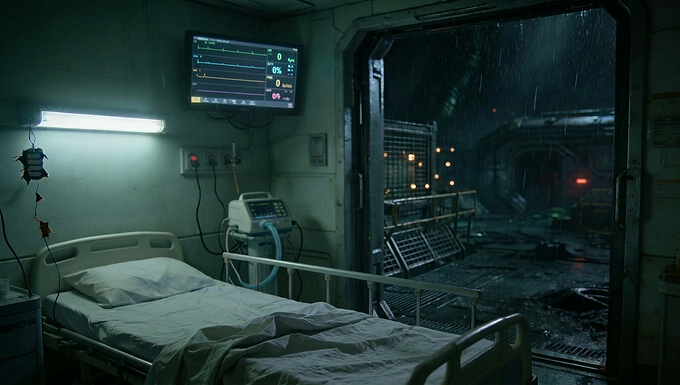
Carrie woke to someone saying her name, over and over, from very far away.
“Dr. Schrader. Carrie. Come on, wake up.”
A hand shook her shoulder. The on‑call room light was too bright when she forced her eyes open, stabbing straight through the sandpaper grit behind her lids.
The familiar tug of the higher gravity pulled at her muscles, and the dull ache low in her back reminded her exactly where she was and what she’d been doing for the past sixteen hours.
“Eric?” she rasped.
Eric Stryder’s face swam into focus above her. His hair was plastered to his forehead, his jacket and shirt soaked through, a small puddle forming on the floor where the water ran off his sleeves.
“Yeah. Sorry.” His voice was tight. “We’ve got a situation in Med. You need to see it.”
She pushed upright, the room tilting for a second. Nausea rolled through her—part exhaustion, part first‑trimester rebellion—and she swallowed it back.
She had meant to lie down for ten minutes. Fifteen at most. Just long enough to get her feet back under her before another round of charting and worry about Kit’s ketones, Ellie’s first week of cross‑training, Jackson’s sprained ankle, the sprayer burn on Janel’s hand.
“How long was I out?” she asked, reaching for her coat. The sleeve caught on the cot frame; she tugged it free with a muttered curse.
Eric hesitated. “About two hours.”
“That can’t be right.” Her brain tried to reorder the night. The last time she’d checked the wall chrono it had been a little after midnight. She’d taken her prenatal, forced down three crackers because anything else sounded like a direct route to the toilet, and told herself she would close her eyes until the next alarm.
“What kind of situation?” she asked, already standing.
They stepped into the corridor. The lights were turned down to low twilight, the way they always were during colony sleep cycles.
The storm outside roared against the walls, a low, constant thunder that masked other sounds.
“It’s Zradce,” Eric said.
The name hit her like cold water. Nathan Zradce was a constant presence in her mental inventory of patients and problems: ventilator settings and reposition schedules, decubitus risk, Ellie’s first awkward attempt at suctioning him, the simmering resentment in the colony every time his name came up.
“Did the vent fail?” Carrie asked. “Is he coding?”
Eric shook his head. “He’s not in his bed.”
The corridor seemed to narrow around them.
“That’s not funny,” she said.
“I’m not joking.” His tone left no room for doubt. “We got a call from Jennifer Lennox. She says Nathan showed up at her house.”
“That’s—” Her mind supplied a dozen objections at once. “No. That’s impossible. His scans—”
“Yeah. I know what his scans say.” Eric’s jaw flexed. “All I can tell you is Jen sounded terrified, and Nathan’s room is empty.”
They walked faster.
The small isolation room they’d turned into his private purgatory sat at the end of a short, rarely used hallway off the main bay.
Carrie remembered insisting on it, insisting he be out of sight of the general ward. Out of sight but not quite out of mind.
If I didn’t keep him here, someone might finish the job Medry started. And who would blame them? she had said, half to Ellie, half to herself.
She reached the door and saw at once what Eric meant. It was standing slightly open.
Her heart climbed into her throat.
She put a hand on the panel and pushed.
The bed was empty.
Sheets hung in a distorted mess, half on the floor, half twisted on the mattress.
The ventilator stood silent and dark, power light off.
The multi‑parameter monitor on the wall showed a frozen readout, the main display overlaid by an alert panel. Adhesive sensor pads were scattered like pale coins across the sheet and floor, some still trailing thin leads.
Carrie stepped in on autopilot, her clinician’s eye cataloging details even as her thoughts stuttered.
IV line pulled, no active bleed. Catheter gone.
Her gaze jerked upward, to the small alarm display built into the wall just below the ceiling. A neat column of timestamps glowed in soft orange.
ALARM: LEAD DISCONNECT – 01:12
ALARM: RESP APNEA – 01:14 (ESCALATED)
ALARM: VENT CONNECTION LOST – 01:16 (ESCALATED – NO RESPONSE)
No response.
The words seemed to thicken the air.
“Who cleared it?” she asked, although she could see the answer: no acknowledgment. No override code. No staff initials.
Eric stepped in behind her and followed her gaze. He swore, low. “NARA didn’t bump it base‑wide. We lost half the external sensor grid when the storm rolled in. She dropped most of the non‑critical internal feeds to local only.”
Local. Right here in Med. Within earshot of the nurses’ station. Just a few doors away from the on‑call room.
“I should have heard it,” Carrie said. Her voice sounded thin in her own ears. “Even on low volume. I should have—”
“You’ve been up nearly thirty hours,” Eric said quietly. “And you’re pregnant. You finally lay down and your body did what bodies do. This isn’t—”
She cut him a sharp look. “Don’t tell me this isn’t on me.”
Her hand found the back rail of the bed, fingers tightening until her knuckles blanched. She saw herself as she must have looked when she stumbled in here earlier with Ellie: efficient, irritated, that small flare of grim satisfaction she hated admitting even to herself when she said he was “not worth” the resources, that he wasn’t really a patient so much as a machine‑dependent body they were obligated to maintained.
Every time I come in here, I think of everyone who could have died, and I… She had stopped herself then.
Ellie had understood anyway.
“You told us he wouldn’t ever wake,” Eric said, softer. “You told the Council he was functionally gone.”
“Because that’s what the data said,” Carrie snapped. “Because on Earth, with a full neurosurgical team and rehab, he might have had a sliver of a chance. Here, with three nurses and a half‑stocked Med Bay? No.”
She dragged in a breath that tasted of disinfectant and metal and the faint, sour trace of sweat. The room still smelled like him—or rather, like an unoccupied patient room: stale air, plastic, antiseptic.
She forced herself to walk the short space to the door, then back again, tracing his likely path. Off the bed. To the monitor. To the vent.
He had the presence of mind to shut the machines down. To pull his own lines. To find the door.
The floor by the threshold showed a faint track of damp footprints, already drying.
“He walked,” she said. Saying it made it real. “On his own. In higher gravity. After months of atrophy.”
“There are prints in the corridor too,” Eric said. “Sebring and James followed them to the back exit. After that…” He shrugged. “Rain washed away any footprints.”
The storm roared again, as if to punctuate his words.
Carrie stared at the empty bed. She couldn’t stop seeing him as he had been on the Cryo deck videos: moving with purpose, methodical, merciless. Deeks’ blood pouring down his chest, so clear on the screen. Evers dropping boneless to the floor. The timer counting down on the Cryo systems he’d sabotagedafter he cut the video feed.
She had watched those vids alone, the way Jennifer had.
“If he kills anyone out there,” she said quietly, “it’s because I didn’t wake up.”
“That’s not fair,” Eric said.
“It’s accurate.” She let go of the rail. Her hands were shaking. “I insisted he stay here, and I’d take primary responsibility. Hell, I even refused to sign off on discontinuing life support when the Council pushed it, because I still believe in the Hippocratic Oath. And then I lay down and slept through three escalating alarms.”
Her other hand went, unbidden, to the slight firmness of her lower abdomen. It was barely a bulge, nothing anyone else would notice under the boxy Med scrubs, but she felt it constantly: when she bent, when she stood too fast, when nausea hit in the middle of a dressing change.
She had told herself that staying on duty through the first trimester was manageable, that she could give Kit lectures on rest and hydration and then go right back to double shifts because someone had to.
Now there was a patient missing—a killer on the loose—because she had failed to wake up.
Eric glanced at her hand, then away. “Sebring’s got teams mustering. We’ll grid the settlement and the treeline as far as we can in this weather. I’ll need you to draft the medical advisory for the alert.”
“Medical advisory.” The phrase almost made her laugh. “What am I supposed to write, Eric? ‘Known mass‑murder suspect, previously believed vegetative, is now ambulatory and at large. Approach with extreme caution’? Or ‘Due to recent weather events, please be aware that the man who tried to kill more than two hundred of us may be knocking on your door’?”
“‘Do not engage. Report any sighting immediately,’” he said. “We’re not asking anyone to be a hero.”
But someone would, she just knew it. Someone whose partner or parent had died in those days on Calypso. Someone who had watched the vids and seen the same efficient, unhurried brutality.
If they found Nathan first, alone, she doubted they would call Med for an evaluation.
And if he found them first—
Her mind supplied too many possibilities, each one worse than the last.
She stepped out into the hallway. The emergency glow strips cast everything in pale gold, the little supply closet suddenly looking like a mouth opening onto darkness.
She had wanted him out of sight to spare the others from the daily reminder of what he’d done. Now the thought of that cramped, hidden room made her skin crawl.
“Send me the alert template,” she said. “I’ll have language for you in five minutes.”
Eric caught her elbow as she started toward the nurses’ station. “Carrie.”
She stopped.
“Never forget that you did your job,” he said. “You kept him alive because that’s what you do. You closed your eyes because you’re carrying a child and you’re exhausted. None of that makes you responsible for what he chooses to do if he’s… if he’s truly back.”
His words didn’t touch the cold knot forming in her chest. Responsibility wasn’t a switch she could flip off because circumstances were inconvenient.
“If he hurts anyone else,” she said, meeting his eyes, “it will be with a body I kept breathing and a brain I said would never wake or even really function. I don’t get to shrug that off.”
He didn’t argue again. After a moment, he let her go.
At the nurses’ station, she pulled up the colony alert system. The cursor blinked in the empty message field, waiting. Her hands hovered over the keys for a second. The storm’s constant roar filled the silence, and beneath it she could hear, dimly, the stirrings of Sagan Base waking up: doors opening, voices rising, children crying as parents lifted them from warm beds.
She began to type.
Nathan Zradce, patient previously housed in Medical Isolation Room 3, has left the facility without authorization and is believed to be moving on foot within or near Sagan Base. Subject has a history of extreme violence. If sighted, do not approach. Shelter in place and contact Security immediately.
Her fingers hesitated over the send command.
No mention of how long he’d been gone before anyone noticed. No mention of the alarm log. Those details would go in her incident report, in the quiet, clinical language that stripped events down to sequence and cause.
They would not capture the image that would stay with her: an empty bed, a tangle of sheets, a line of alarms she had slept through while a man she had written off as gone stood up, turned off his machines, and walked into the night.
She sent the alert.
Outside, the rain hammered on, steady and indifferent.
If he kills again, she thought, it will be because I wasn’t there when the machines tried to tell me he was waking up.
And she knew, with the cold certainty that settled in her bones, that there would be no version of events—not Security’s, not the Council’s, not the one in her own report—where she would ever fully absolve herself.